AI for Trade Shows: What to Expect, What Not to Expect, and How Exhibitors Are Actually Using It
Ask ten exhibit managers how they use AI for trade shows and the answers range from “it writes our follow-up emails” to “it designed our whole booth” to “we tried it and went back to the old way.” All three are true at once, which is why the conversation about AI in the events industry sounds so contradictory. The tools are real, the enthusiasm is real, and so is the quiet disappointment that shows up a few months after the pilot.
The survey data captures that split. Among event professionals, 59 percent already use AI for event content, yet only 37 percent say it delivers measurable results, according to a 2026 Forrester Consulting study commissioned by Cvent’s Center for Event Insights. A Northstar Meetings Group and Cvent poll from late 2025 found that 49 percent of planners say AI has sped up some processes but “the overall impact has not been significant.” In the broader marketing world, Social Media Examiner’s 2026 survey of 681 marketers found 73 percent using AI daily, while nearly nine in ten believe it saves time and fewer than one in three can show measurable results.
This guide is an industry-standpoint look at where that gap comes from and how to stay on the right side of it. It walks through the exhibitor cycle in order, from show selection to post-show follow-up, and for each stage separates what AI reliably does today from what it is still promising. The goal is not to talk anyone out of AI. It is to set expectations so that the time AI saves is real.
1. Separate the Three Jobs AI Is Being Asked to Do
Most disappointment traces back to asking one tool to do three different kinds of work. In the trade show cycle, AI shows up as:
- Language work. Drafting, summarizing, translating, extracting. Emails, talking points, meeting notes, session descriptions, lead qualifiers. This is where results are most consistent, because the output is text and a person can check it in seconds.
- Image and concept work. Booth renderings, mood boards, graphic ideas, social visuals. Excellent for exploration; unreliable as production files, for the reasons covered in step 4.
- Prediction and matching. Attendee-to-exhibitor matchmaking, lead scoring, at-risk exhibitor flags, recommendation engines inside event apps. Powerful when the underlying data is rich; weak when profiles are thin or events are small.
The balancing caveat: one vendor often bundles all three, and the demo leads with whichever looks most impressive. Judge each job on its own evidence.
Which of these three jobs am I actually buying, and what does “it worked” look like for that job specifically?
2. Use AI to Research Shows and Prospects Before You Commit
The pre-show research phase is where AI delivers the clearest, lowest-risk return, and it is the stage exhibitors most often skip. Language models are good at reading long documents and answering targeted questions about them: exhibitor prospectuses, past attendee demographics, competitor exhibitor lists, session agendas. Used this way, AI compresses hours of reading into a short list of facts to verify.
Practical uses that hold up:
- Summarizing an exhibitor prospectus into booth sizes, deadlines, included services, and rules that affect the booth (height caps, hanging-sign eligibility, line-of-sight).
- Building a prospect list from a published exhibitor or speaker roster, then drafting personalized talking points per target account.
- Comparing two or three candidate shows against your own criteria (audience fit, cost, timing, competitor presence) in a single structured table.
What to expect: a faster first pass, not a decision. Verify every date, price, and rule against the source document, because models occasionally invent plausible specifics. The show list itself should come from a maintained directory rather than from the model’s memory; the TradeShows.fyi event directory is the reliable starting point for dates, venues, and organizers, and AI is the tool for digesting what you find there faster.
3. Treat AI Content as a Draft That Needs a Human Edit
Content generation is the most adopted AI use in events, with 83.8 percent of event professionals using it according to the 2024 ICE Benchmarking Report. It is also the use most likely to produce generic output. Pre-show emails, social posts, session abstracts, and booth signage copy all come out fluent and interchangeable unless the prompt carries real specifics: the product, the audience, the show, the offer.
The pattern that works is to give AI the facts and ask for structure, then rewrite the voice. The pattern that fails is asking for “a trade show email” and sending what comes back. Accuracy concerns are the top worry among marketers using AI, at 78 percent in the Social Media Examiner survey, and the practical version of that worry is a product claim or a booth number that the model made up.
What not to expect: brand voice without a brand brief. Models write in the average voice of everything they have read. If the copy needs to sound like your company, supply examples of your company’s writing and edit the result.
4. Use AI to Concept the Booth, Then Hand It to a Designer
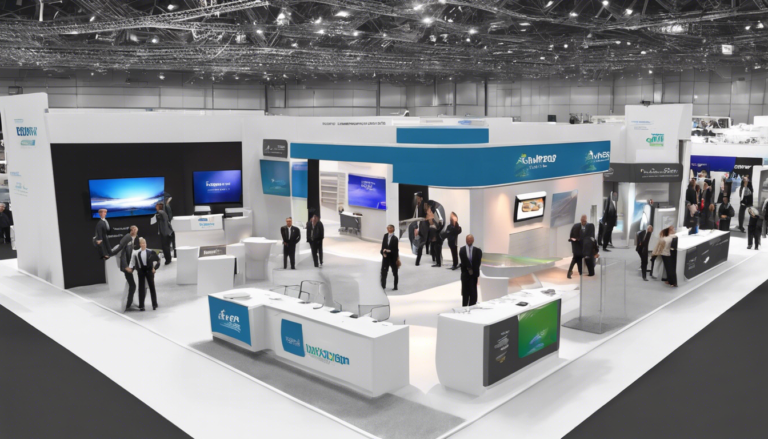
Booth design is where AI generates the most excitement and the most friction with exhibit houses. Image generators produce convincing booth renderings in seconds, and exhibitors increasingly send those renderings to display providers and ask for a build. The industry consensus is consistent: the rendering is creative direction, not a design.
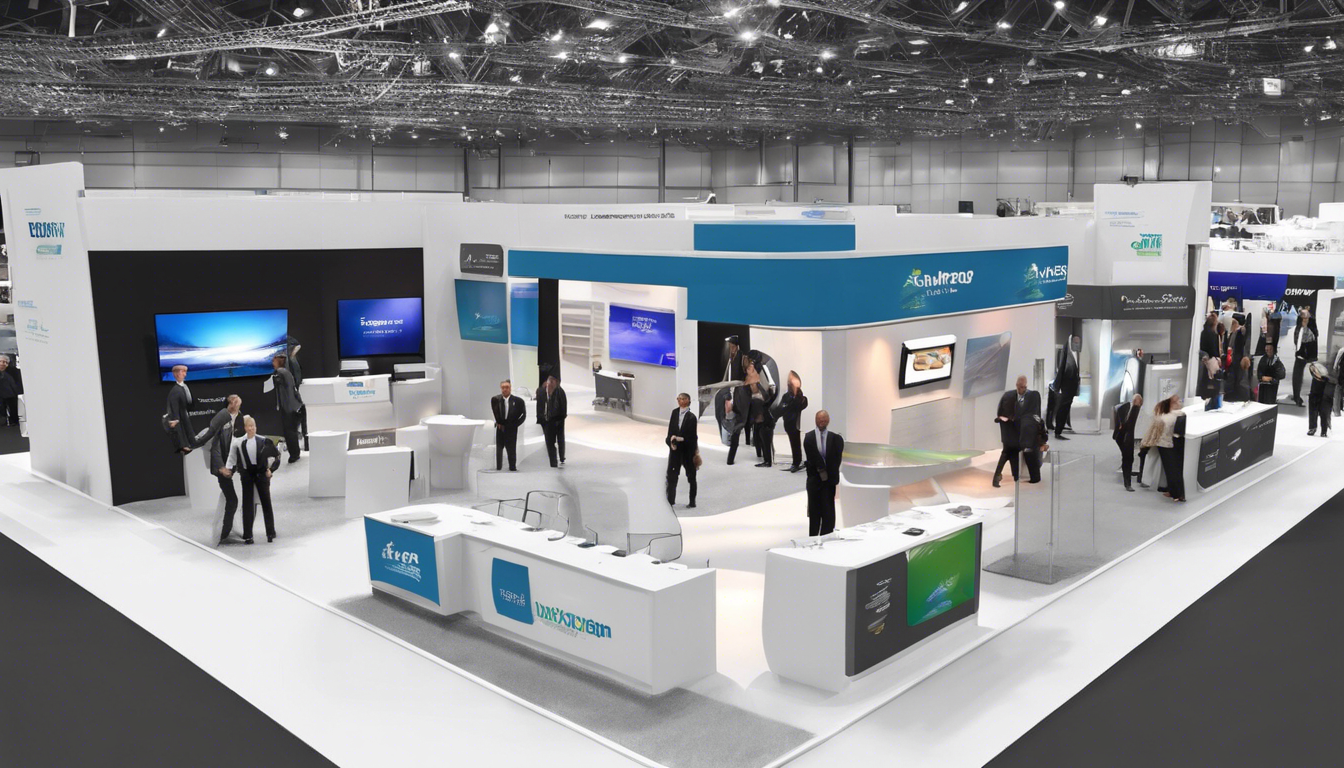
Two things are reliably true of AI booth renderings. First, they ignore physics and show rules: floating headers, signs hung from pipe and drape, 12-foot backwalls in inline spaces capped at 8 feet, backlit panels with no power source. Second, the image file itself is far below print resolution. A typical 1536-pixel AI image spread across a 10-foot backwall works out to about 13 dpi against a large-format target of roughly 100 dpi, and the text in it is pixels, not type, so it cannot be used as-is on a printed graphic.
What to expect: a fast way to find the look you want and communicate it. What not to expect: a file a printer can use. The step-by-step method for getting from an AI concept to a buildable, printable booth is covered in the companion guide, AI Generated Trade Show Booth Designs: A Step-by-Step Guide to Using Them Without Regret.
5. Decide Whether AI Matchmaking Will Help at This Show
AI matchmaking inside event apps is the most heavily marketed organizer-side feature, and the results vary more than the marketing suggests. Event-networking platforms report real gains where it works: Converve cites a 44 percent year-over-year increase in meetings at Clarion Events shows, and Swapcard reports AI recommendations doubling match acceptance rates. The same vendors are candid about when it does not.
Matchmaking depends on registration data. Thin attendee profiles generate thin matches; late registrants get worse recommendations because the system has nothing to go on; small events under roughly 150 attendees are often better served by an organizer who simply knows the room. Hosted-buyer programs with guaranteed meeting quotas and association events with their own political considerations also tend to override the algorithm.
For an exhibitor, the practical questions are: does this show’s app actually use behavioral data or only registration tags, how complete are attendee profiles, and will the organizer share match-acceptance or kept-meeting rates from the prior year? A platform that cannot answer the third question is asking you to take it on faith.
What to expect: more meeting requests at large shows with rich data. What not to expect: qualified buyers surfacing automatically at a regional show where half the attendees registered the week before.
6. Put AI to Work on Lead Capture, Where the Gap Is Largest
Lead handling is where the industry’s performance has been weakest for the longest, which makes it the stage where AI has the most room to help. EXHIBITOR Magazine’s Sales Lead Survey, still the most-cited benchmark in the exhibit industry, found that only 22 percent of exhibitors respond to leads within 24 to 48 hours after a show, and 69 percent of face-to-face marketers pass every lead to sales without qualifying it. The cost of that delay is well documented outside the industry as well: the Harvard Business Review study of 1.25 million leads across 42 companies found that firms contacting a lead within an hour were nearly seven times as likely to qualify it as those that waited even one hour longer, and that 23 percent of leads were never contacted at all.
AI-assisted lead capture addresses those gaps directly. Current tools scan badges and business cards, transcribe a staffer’s voice note recorded right after a conversation, turn it into a CRM-ready summary, score the lead as hot, warm, or cold from the notes and survey answers, route it to the right rep, and draft the first follow-up email while the conversation is still fresh. Phone- and tablet-based capture apps have largely replaced rented badge scanners, which is what makes the voice-note step practical: the device the staffer is already holding is the recorder. So lets take a look at what AI for Trade Shows can and can’t do.
What to expect: dramatically faster, better-documented follow-up, provided staff are trained to record the note. What not to expect: the tool to fix a process that was never defined. In the Cvent study, only 36 percent of event professionals said they fully capture and integrate event data across all their events, and 71 percent said managing events across disconnected tools limits their visibility into results. In practice, leads captured on-site frequently still need a human to move them into the CRM. Confirm that integration before the show, not after.
7. Draft the Follow-Up With AI, Send It Like a Person
Post-show follow-up is the single highest-return language task in the cycle. Given a voice note or a few bullet points per lead, AI drafts a personalized email that references the actual conversation, which is what separates a reply from a deletion. Exhibit marketers who have tested this workflow describe the administrative friction dropping enough that follow-up actually happens within the first 48 hours rather than the following week.
Three guardrails keep it from backfiring:
- A person reads every email before it goes out. The model will occasionally confuse two conversations or promise something the booth staffer never said.
- Follow-up emails go out from a person’s address, in that person’s voice, with the specific detail from the booth conversation in the first two lines.
- The CRM record, not the email, is the deliverable. The summary AI writes should be good enough that a rep who was not at the show can pick up the thread.
8. Protect Attendee Data Before Pasting Anything Into a Chatbot
This step is short because the rule is simple, and it is the one most often skipped. Attendee lists, badge-scan exports, and lead notes contain personal data covered by GDPR, CCPA, and in some cases contractual limits set by the show organizer. Uploading that data into a consumer AI tool without a data-processing agreement is a compliance exposure, and event-tech vendors now describe this “shadow AI” use as one of the most common mistakes they see.
Data privacy is the second-largest concern among marketers using AI, at 77 percent in the 2026 Social Media Examiner survey. The practical rule: use AI tools that sit inside your lead-capture or CRM platform under its data agreement, or use an enterprise AI account with data controls, and never paste a raw attendee export into a free chat window.
9. Scorecard: Will AI Help at This Stage?
Before adopting an AI tool for any part of the show cycle, score the use case on the five factors below from 1 (weak) to 5 (strong). A total of 20 or more is a good bet; 14 to 19 needs one specific fix first; below 14 is a pilot, not a plan.
| Factor | 1 | 5 |
|---|---|---|
| Output is easy for a person to check | A prediction or score with no visible reasoning | A draft a staffer can read and correct in under a minute |
| Input data is rich and clean | Thin profiles, last-minute registrations, no notes | Complete profiles, structured notes, CRM history |
| A clear process already exists | “We’ll figure out follow-up after the show” | Defined owner, timing, and CRM fields for every lead |
| Data handling is covered | Pasting exports into a consumer chatbot | Tool runs under a data-processing agreement |
| Success is measurable | “It feels faster” | Response time, kept meetings, or pipeline tracked before and after |
The scorecard is deliberately hard on the last row. The industry’s 22-point gap between AI adoption (59 percent) and measurable results (37 percent) exists largely because no one defined the measurement before switching the tool on.
10. Measure the Only Three Numbers That Matter
AI vendors report engagement metrics. Exhibitors need business metrics. Three are enough, and all three can be tracked by hand in a spreadsheet:
- Lead response time. Hours from badge scan to first personal follow-up, median and worst case. This is the number AI should move first and most.
- Qualified-lead rate. Share of captured leads that sales accepts as real opportunities. AI scoring is only helping if this rises or sales time per lead falls.
- Meetings kept. For matchmaking features, requested meetings versus meetings that happened. Matchmaking platforms such as Converve cite kept-meeting benchmarks of around 80 percent at well-run events; a show app delivering far below that is generating requests, not relationships.
Track these for one show without AI and one show with it. The comparison settles most arguments about whether the tool is working.
What Makes AI Worth It at a Trade Show
AI pays off at trade shows when it removes work that was keeping people from doing the human part: reading the prospectus, writing the follow-up, moving notes into the CRM. It disappoints when it is asked to replace the human part itself, whether that is the judgment about which show to attend, the design of a booth that has to physically stand up, or the conversation that turns a badge scan into a customer.
The Freeman 2026 Trends Report, drawn from more than 3,300 attendees and exhibitors, found that attendees rate learning from networking and exhibitor engagement as slightly more valuable than traditional conference sessions. Seventy percent of event professionals in the Cvent study say live events matter more as AI spreads, not less. The industry’s own read is that AI makes the in-person part more valuable by clearing the administrative part out of the way. Exhibitors who use it that way are the ones reporting measurable results.
Track It and Improve Next Year
After each show, record which AI tools were used at which stage, the three metrics above, and one sentence on what the team would change. Over two or three shows, the log shows which uses are compounding and which are still experiments. Keep the prompts and templates that worked in a shared document. The biggest productivity gain from AI in event marketing is not the first draft; it is the reusable process that produces the fiftieth.
Finding the Show and Building the Booth
Every stage above starts with the right show on the calendar. Search the TradeShows.fyi event directory to find events by industry, location, and date, reach each organizer’s exhibitor information, and build the list that AI can then help you research.
When the concept is settled, you need a booth that can be built, printed, and shipped on a real timeline. APG Exhibits, a family-owned trade show display company with more than 50 years in the business, sells and rents portable, modular, and backlit trade show displays, and has an in-house design team that routinely turns AI-generated concepts into buildable, print-ready graphics, including upscaling usable imagery and recreating logos and type in vector.
Frequently Asked Questions
How are exhibitors using AI for trade shows?
The most common uses are content drafting (pre-show emails, social posts, signage copy), pre-show research (summarizing prospectuses and building prospect lists), booth concept renderings, AI-assisted lead capture with voice-note transcription and lead scoring, and drafting personalized post-show follow-up. Content generation is the most adopted use, at around 84 percent of event professionals.
Does AI actually improve trade show results?
Where it is applied to language and process tasks, yes: faster follow-up, better-documented leads, less admin. Survey data shows the gap, though. Fifty-nine percent of event professionals use AI for content, but only 37 percent report measurable results, usually because success was never defined before the tool was adopted.
What should exhibitors not expect from AI?
Do not expect print-ready booth graphics from an image generator, qualified buyers from matchmaking at small or thinly registered shows, brand-voice copy without a brand brief, or a lead-capture tool to fix a follow-up process that was never defined. AI accelerates a process that exists; it does not create one.
Is AI matchmaking at trade shows worth it?
At large shows with rich registration data, platforms report substantial gains in meetings and match acceptance. At events under roughly 150 attendees, with thin profiles, or with hosted-buyer quotas, an organizer who knows the room often outperforms the algorithm. Ask the organizer for last year’s match-acceptance and kept-meeting rates before relying on it.
Can AI help with trade show lead follow-up?
This is one of the highest-return uses. Only about 22 percent of exhibitors follow up within 48 hours, and leads contacted within an hour are far more likely to qualify than those left for a day. AI that transcribes booth notes, scores leads, and drafts a personalized first email can close that gap, provided a person reviews each email and the CRM integration is confirmed before the show.
Is it safe to put attendee lists into ChatGPT?
Not into a consumer account. Attendee and lead data is personal data under GDPR, CCPA, and often the show’s own terms. Use AI features inside your lead-capture or CRM platform under its data-processing agreement, or an enterprise AI account with data controls, and never paste a raw export into a free chat window.
Can AI design a trade show booth?
AI can generate convincing booth concepts, which are useful for choosing a direction. The renderings routinely include unbuildable elements and are far below print resolution, so a designer rebuilds the concept on the correct display template using real hardware, vector logos, and live type. The companion guide covers that process step by step.
What is the best first AI project for an exhibitor?
Post-show follow-up. It has the clearest baseline (response time), the easiest human check (read the email), the richest input (your own booth notes), and the most direct business impact. Start there, measure it, and expand to pre-show research and content once the process is proven.
About the Author