

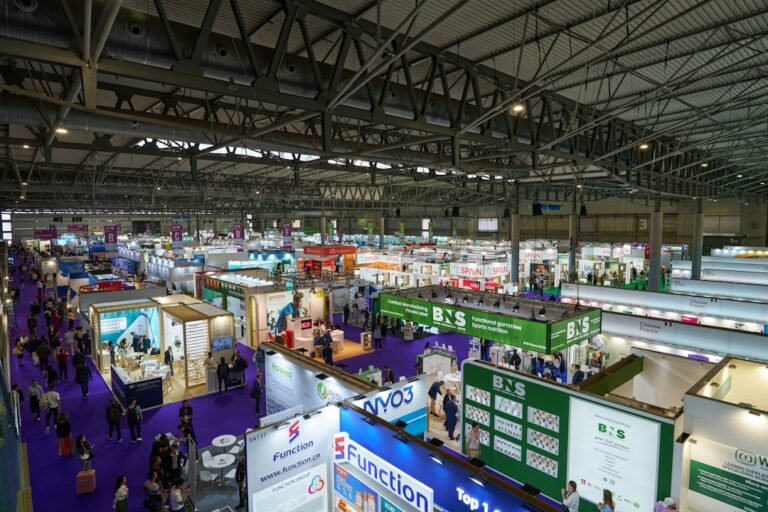
Photo by <a href='https://unsplash.com/@transrussia?utm_source=tradeshows_fyi&utm_medium=referral'>Trans Russia</a> on <a href='https://unsplash.com/?utm_source=tradeshows_fyi&utm_medium=referral'>Unsplash</a>
Every trade show runs on a second event that most attendees never see: trade show logistics. Days before the doors open, freight trucks line up in a marshalling yard, forklifts move crates down empty aisles, and electricians run power to hundreds of booths on a schedule set months in advance. Exhibitors who understand that event spend less and arrive calmer. Exhibitors who don’t often meet it for the first time on an invoice.
Trade show logistics covers everything required to get an exhibit, its products, and its people into the hall, working, and back out again: shipping, material handling, labor, utilities, housing, and the paperwork that ties them together. The rules change from show to show and venue to venue, which is exactly why first-time exhibitors get caught out.
This guide walks through the process in the order it actually happens, from the day the exhibitor manual arrives to the morning the empty crates come back. Each step explains who controls it, what to do, and where the costs hide.
1. Learn Who Controls Trade Show Logistics at Your Show
A trade show floor is a temporary city with several governments. Knowing which one owns each task tells you where to order, who to call, and which rules apply.
| Role | What they control | When exhibitors deal with them |
|---|---|---|
| Show organizer (show management) | Booth space, exhibitor rules, the schedule, and the choice of official contractors | Space contract, booth assignment, rules questions |
| General services contractor (often called the official services contractor) | Freight receiving, material handling, furniture and carpet rental, signage, and usually labor | Most orders in the exhibitor manual |
| Venue (convention center or hotel) | The building, plus services it often keeps in-house, such as electrical, utilities, internet, and food and beverage | Power, internet, catering, building rules |
| Exhibitor-appointed contractors (EACs) | Installation and dismantle, booth building, and other services an exhibitor hires directly | When bringing an outside setup crew or exhibit house |
| Freight carriers and logistics companies | Moving freight to and from the show | Inbound and outbound shipping |
| Official housing bureau | The show’s hotel room blocks | Booking rooms for booth staff |
Large shows commonly use national general contractors such as Freeman or GES, while smaller events may use regional firms. The names change, but the structure stays the same: the organizer chooses the official providers, and exhibitors order through them.
For every task on the list, who is the official provider, and what is their deadline?
Not every service is exclusive. Many shows let exhibitors bring their own setup crew or hand-carry small items, but they attach conditions. The exhibitor manual for your specific show is the final word, ahead of any general advice, including this guide.
2. Get the Exhibitor Manual and Build a Trade Show Logistics Calendar
The exhibitor services manual, also called the exhibitor kit or service kit and today usually an online ordering portal, is the operating manual for your show. It lists the official contractors, every order form, the freight addresses, move-in and move-out schedules, and the rules for labor and booth construction.
Read it the week it arrives and pull every date into one calendar:
- Advance-order discount deadlines for furniture, carpet, electrical, internet, and labor
- The advance warehouse receiving window and its final date
- Your targeted move-in date and time for direct shipments
- Notice-of-intent and insurance deadlines for any outside contractor
- The hotel block cutoff date
- The outbound carrier check-in deadline at the end of the show
Deadlines matter because contractors commonly price in tiers, with lower rates for orders placed by the advance deadline and higher rates for later or on-site orders. Late freight can be expensive too: one logistics provider estimates that missed delivery windows can raise drayage charges by as much as 50% (EFW).
A Typical Trade Show Logistics Timeline
A common working schedule looks like this. Every show sets its own dates, so treat it as a starting template and replace each line with the dates in your manual.
| When | Logistics task |
|---|---|
| As soon as the manual arrives | Read it, list the official contractors, and build the deadline calendar |
| 8 to 12 weeks out | Finalize booth design, piece count, and weights; book the carrier; check the hotel block |
| 6 to 8 weeks out | Submit any outside-contractor notice of intent and insurance certificate |
| 4 to 6 weeks out | Place utility, rental, and labor orders before discount deadlines |
| 2 to 4 weeks out | Ship to the advance warehouse inside its receiving window |
| Final week | Confirm direct-to-show target times, the outbound carrier, and on-site contacts |
| Show close | Turn in outbound paperwork and stay until freight is released |
Ordering early is not always cheapest if booth plans are still changing, because cancellations after a deadline may not be refundable. Lock the design first, then order everything together before the discount date. For a month-by-month view of the whole program, see the 12-month trade show planning timeline on Trade Show Event Directory.
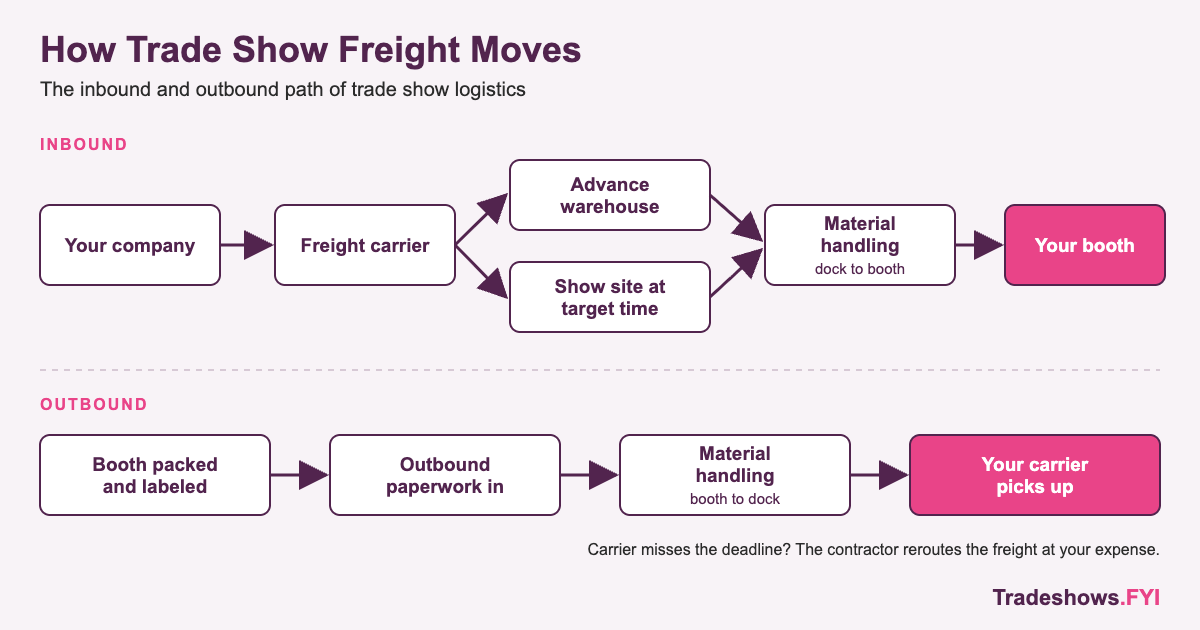
3. Choose Advance Warehouse or Direct-to-Show Shipping
Most shows give exhibitors two ways to get freight to the booth.
Advance warehouse. Freight goes to the general contractor’s warehouse ahead of the show, where the contractor stores it and then delivers it to the booth before the exhibitor arrives. One Freeman exhibitor freight guide describes its warehouses accepting crates, cartons, skids, and cases starting 30 days before move-in, with loose or pad-wrapped items sent directly to the show site instead (Freeman freight services information).
Direct to show site. Freight arrives at the venue during move-in, usually at an assigned target date and time. At ICFF 2026, for example, Freeman’s advance warehouse received freight from April 15 to May 6, while show-site receiving began May 14 on assigned target times (ICFF 2026 freight information).
| Factor | Advance warehouse | Direct to show site |
|---|---|---|
| Timing risk | Low, because freight is in hand days or weeks early | Higher, because a late truck can mean a late booth |
| Booth readiness | Freight is usually waiting in the booth at setup | Setup starts when the truck is unloaded |
| Freight types | Generally crated, boxed, or skidded freight | Also takes loose, pad-wrapped, and oversize items |
| Cost exposure | Late arrivals at the warehouse can add charges | Missing the target window can add charges |
| Best for | Smaller exhibits, tight travel schedules, first-time exhibitors | Large exhibits, exhibit-house trucks, freight that can’t be crated |
Some shows reward on-time direct shipments. PACK EXPO, for example, includes material handling for direct shipments in the space rate when trucks check in at its marshalling yard by the assigned target time (PACK EXPO International service manual). Read the manual before assuming the warehouse is always the safer or cheaper choice.
4. Pack, Weigh, and Label Every Piece
Most trade show logistics problems start with paperwork, not freight. Receiving docks handle thousands of pieces, and anything that can’t be matched to a booth slows down or goes missing.
- Label every piece with the exhibiting company, booth number, and show name, using the contractor’s warehouse or show-site label as directed. This guide to trade show shipping labels shows what a complete label includes.
- Number the pieces (1 of 6, 2 of 6) so a missing item is noticed at the booth rather than after the show.
- Weigh every shipment and list the piece count and weight on the bill of lading. Freeman’s freight guide calls for certified weight tickets with every shipment and notes that shipments are subject to reweigh.
- Ship prepaid. The same guide notes that collect shipments are returned to the carrier.
- Prefer crates and cases over loose items, since contractors often charge more for uncrated or pad-wrapped freight.
- Keep a packing list with photos of how everything fits, so the return pack-up goes faster.
Parcel deliveries deserve a warning. Freeman’s guide states that the contractor delivers shipments that arrive without receipts, such as many small-package deliveries, with no guarantee of piece count or condition. Parcels work for brochures and last-minute items, but the booth’s core pieces belong on a documented freight shipment.
5. Understand How Material Handling Is Billed
Material handling, also called drayage, is the charge for moving freight from the dock or warehouse to the booth, storing empty containers during the show, and reversing the process at move-out. It is usually the largest line item in a trade show logistics budget and the one exhibitors most often underestimate. One logistics provider suggests it can reach up to a third of show expenses (EFW). For a deeper breakdown, see Drayage Explained on Trade Show Event Directory.
Two billing models are in use today.
Hundredweight (CWT) Pricing
The traditional model bills per 100 pounds. A 2023 overview from logistics firm DTS put typical US rates between $60 and $160 per CWT (DTS). CWT schedules usually add a minimum per shipment, commonly 2 CWT (200 pounds), plus surcharges for special handling, overtime, or late arrival. EFW notes that special handling alone can add up to 30%.
Per-Pound Pricing
A growing number of shows bill per actual pound instead. Freeman’s ICFF 2026 information describes per-pound pricing with no minimums, no crated or uncrated distinction, no special handling, no overtime charges, and no rounding (ICFF 2026).
How to Estimate Material Handling Costs
To estimate a CWT charge before the invoice arrives, use this formula:
Material handling estimate = (billable weight ÷ 100) × rate per CWT × (1 + surcharge %)
Billable weight is typically the shipment’s weight rounded up to the next 100 pounds, or the show’s minimum, whichever is higher. Rounding rules differ by contractor, so confirm them on your show’s rate sheet.
Illustrative example, not a quoted rate: a 640-pound crate counts as 700 pounds, or 7 CWT. At a hypothetical $100 per CWT, that comes to $700. If the crate also needs special handling at a 30% surcharge, the estimate becomes $910.
The minimum is where small shipments get expensive. Under a 2 CWT minimum, five separate shipments under 100 pounds each count as 200 pounds, adding up to 1,000 billable pounds (EFW). Consolidating them into one shipment cuts the billable weight sharply.
Lighter is not automatically cheaper under every model. With per-pound pricing, consolidation still helps with paperwork and handling time but no longer changes the billing math. Know which model your show uses before redesigning how you pack.
6. Plan Labor: Who Is Allowed to Set Up the Booth
Labor rules are the most location-specific part of trade show logistics. Some venues let exhibitors build almost everything themselves, while others require official or union labor for anything beyond basic tasks.
McCormick Place in Chicago shows how specific these rules get. Its Exhibitor Bill of Rights, in the July 2026 version published by The Inspired Home Show, lets full-time exhibitor employees set up and dismantle booths of any size with their own hand and power tools, hang their own graphics, and plug in their own equipment. Those employees must have worked for the company full time for at least six months before the show opens, and motorized equipment such as forklifts, scissor lifts, and pallet jacks is off-limits (The Inspired Home Show).
When a booth needs more hands, exhibitors typically have two choices:
- Official contractor labor, ordered through the exhibitor manual and supervised either by the exhibitor or by the contractor.
- An exhibitor-appointed contractor (EAC), such as an exhibit house or an independent installation and dismantle (I&D) company. GES, for example, requires a notice of intent to use an EAC at least 30 days before move-in, along with a certificate of insurance from the contractor (GES).
Doing setup in-house saves labor charges, but it costs staff time, travel, and energy before the show even opens. For larger booths, a professional crew often pays for itself in fewer mistakes and a fresher team on opening day. The service provider directory lists companies that support exhibitors.
7. Order Utilities and On-Site Services
Everything a booth plugs into, connects to, or rests on usually has to be ordered. Common orders include:
- Electrical power, outlets, and lighting circuits
- Internet access and dedicated lines
- Carpet, padding, and furniture rental
- Rigging for hanging signs
- Booth cleaning and vacuuming
- Audio-visual equipment and monitors
- Lead retrieval scanners or apps
- Plumbing, water, or compressed air for equipment demos
Venues often keep certain services exclusive, most commonly electrical and internet, so those orders may go to the venue’s in-house provider rather than the general contractor. The exhibitor manual lists who handles each one.
Renting is not always the expensive option. For a one-time show far from home, renting furniture or carpet can cost less than shipping and handling your own. For a booth that travels to several shows a year, owned items usually win.
8. Book Travel and Housing Through Official Channels
Hotel rooms near a convention center can sell out months ahead. Shows usually arrange room blocks through an official housing bureau or a list of partner hotels.
Booking through official channels also protects against fraud. Unaffiliated companies regularly contact exhibitors claiming to represent a show’s housing bureau or offering lower rates. ASME’s warning to Turbo Expo exhibitors notes that bookings through these outfits may not actually hold rooms and may carry harsh change or cancellation terms (ASME). Trade Show News Network has reported that some of these companies appear to pull exhibitor contacts from public floor plans (TSNN).
- Book only through links on the show’s official website or in the exhibitor manual.
- Treat unsolicited calls or emails about rooms or attendee lists as suspect until show management confirms them.
- Check the venue and its surroundings in the venue directory before choosing a hotel.
A hotel outside the block is not automatically a problem. Booked directly with the hotel, it can work well. The risk comes from third parties posing as official.
9. Run Move-In Day Like a Schedule, Not an Errand
Move-in is when the trade show logistics plan meets the loading dock. A few habits keep it on track:
- Confirm freight arrival with the exhibitor services desk as soon as you reach the hall.
- Brief drivers on check-in rules. At ICFF 2026, carriers checked in at the marshalling yard by their target time and needed certified weight tickets; drivers without them had to go to a truck scale first.
- Know the hand-carry rules. At the 2025 EATS show at McCormick Place, exhibitors unloading their own vehicles needed a team of at least two people and had no more than 20 minutes at the dock (GES show work rules).
- Inspect every piece against the packing list before any carrier claim window closes.
- Label empty crates with the contractor’s empty-container stickers so they come back to the right booth.
- Bring a toolkit: tape, zip ties, cleaning supplies, spare graphic hardware, and extension cords where the venue allows them.
Arriving early is not always better. Many halls don’t admit exhibitors or freight before assigned times, and early trucks can end up waiting in the marshalling yard.
10. Plan Move-Out Before the Show Opens
Move-out is where tired teams make expensive mistakes. The fix is to arrange it before the show starts.
- Book the outbound carrier in advance and confirm its check-in time against the show’s deadline.
- Submit outbound paperwork early. Contractors generally require a material handling agreement or outbound bill of lading for every shipment, turned in after freight is packed and labeled.
- Expect a wait for empty containers. Empties come back after the show closes, often in random order, which can take hours. Some shows sell faster returns; at ICFF 2026, a priority empty-return label cost $160 per container.
- Stay with the booth until freight is packed, labeled, and the paperwork is in.
The penalty for skipping these steps is real. If a carrier misses the check-in deadline, the contractor reroutes the freight with a carrier of its choosing, at the exhibitor’s expense (ICFF 2026). The industry calls this forced freight.
Forced freight is not a disaster, since the house carrier is a legitimate shipper. It simply isn’t your price, your carrier, or your timeline.
11. Review the Trade Show Logistics Invoice Before You Leave
Most contractors provide a preliminary invoice at the exhibitor services desk. Review it before leaving the hall, while errors are easiest to fix (EFW). Check:
- Billed weights against your bills of lading and weight tickets
- Surcharges for special handling, overtime, or late arrival, and whether each one actually applies
- Rental items you returned or never received
- Labor hours against what your team actually saw
Not every surprise charge is an error. Many trace back to a missed deadline or an uncrated piece, which is useful information for the next show.
What Makes Trade Show Logistics Work
Every step above points to the same principle: exhibitors lock in most trade show logistics costs weeks before the truck reaches the dock. The exhibitor who reads the manual early, ships documented and well-packed freight inside the window, and books move-out before opening day pays close to the published rates. The exhibitor who improvises pays surcharges, show-site prices, and forced-freight rates for the same booth.
That doesn’t mean every show needs a logistics specialist. A single 10×10 booth with two cases can be managed by one organized person. What scales the effort is the number of pieces, the number of shows, and how unfamiliar the venue’s rules are.
Track Trade Show Logistics Costs and Improve Next Year
Logistics gets cheaper when each show teaches the next one. After every event, record:
- Piece count and weight for each shipment, inbound and outbound
- Freight, material handling, labor, utility, and rental costs as separate lines
- Every surcharge and the reason behind it
- Whether you used the advance warehouse or direct-to-show, and how move-in went
- What your team would do differently
Over a season, that log shows which shows are expensive to reach, whether renting or owning furniture makes sense, and whether a lighter exhibit would pay for itself. It also feeds the bigger question of which shows deserve a place on next year’s schedule; see How to Find the Right Trade Shows for Your Business and The Ultimate Trade Show Exhibitor Checklist.
Find Your Next Show
Logistics planning starts with knowing the show, the venue, and the dates. Search the Trade Show Event Directory to find upcoming events, browse the trade show calendar by month, and look up convention centers in the venue directory.
The exhibit itself also shapes the logistics bill. Lighter, modular displays that pack into rolling hard cases are easier to ship, faster to set up, and cost less to move when handling is billed by weight. APG Exhibits offers a broad range of portable trade show displays, along with cases and bags built to carry them, for exhibitors who want a booth that travels well.
Trade Show Logistics FAQ
What is trade show logistics?
Trade show logistics is the planning and coordination needed to get an exhibit to a show, set it up, run it, and return it. It includes shipping, material handling, labor, utilities, housing, and the order deadlines and paperwork that connect them.
What is drayage at a trade show?
Drayage, also called material handling, is the fee for moving freight from the loading dock or advance warehouse to your booth, storing empty containers during the show, and returning everything to the dock afterward. The show’s official contractor charges it, separately from what your carrier charges to ship the freight.
What does CWT mean in trade show shipping?
CWT stands for hundredweight, or 100 pounds. Under CWT pricing, material handling is billed per 100 pounds of freight, usually with a minimum per shipment. A 640-pound crate is typically billed as 7 CWT.
Should I ship to the advance warehouse or directly to the show?
The advance warehouse lowers timing risk because freight is in hand before move-in, which suits smaller exhibits and first-time exhibitors. Direct-to-show suits large exhibits, exhibit-house trucks, and freight that can’t be crated. Some shows include handling for on-time direct shipments, so compare the rates in your manual.
Can I set up my own trade show booth?
Often yes, but the rules depend on the venue and show. Some venues, such as McCormick Place, let full-time employees set up booths of any size with their own tools, while others limit what exhibitors can do without official labor. Check the labor rules in your exhibitor manual.
What is an exhibitor-appointed contractor (EAC)?
An EAC is any outside company an exhibitor hires to install, dismantle, or service its booth, such as an exhibit house or I&D crew. Shows usually require a notice of intent and a certificate of insurance before move-in; GES, for example, asks for both at least 30 days ahead.
What happens if my carrier misses the outbound deadline?
The show’s contractor reroutes the freight with a carrier of its choosing, at the exhibitor’s expense. This is known as forced freight. Booking the outbound carrier in advance and turning in paperwork on time avoids it.
How do I avoid material handling fees at trade shows?
The fees themselves can’t be avoided, but they can be reduced: consolidate small shipments, crate or case your freight, meet the receiving windows, weigh everything accurately, and hand-carry small items where the show allows it. Under per-pound pricing, reducing total weight matters most.
Sources
- ICFF 2026 freight and material handling information (Freeman)
- Freeman freight services information
- PACK EXPO International service manual: material handling
- EFW: drayage in trade show logistics
- DTS: trade show material handling explained
- GES: exhibit insurance and EACs explained
- McCormick Place Exhibitor Bill of Rights (via The Inspired Home Show)
- GES show site work rules, EATS 2025 at McCormick Place
- ASME Turbo Expo: hotel scam warning
- TSNN: hotel room block poachers
About the Author



3 thoughts on “Trade Show Logistics: How to Ship Smarter and Save Money”
Comments are closed.