distributors, partners, suppliers, and industry professionals. But simply attending more events
does not guarantee better results.The real challenge is finding the right trade shows.
An event may attract a large crowd but very few qualified buyers. Another may be smaller yet
deliver exactly the audience your company needs. Location, timing, exhibiting costs, attendee
demographics, competitive presence, and your business objectives all affect whether a show
deserves a place on your marketing calendar.
This guide explains how to find trade shows, compare opportunities, and build an event schedule
based on business value rather than name recognition alone.
1. Start With a Clear Trade Show Objective
Before searching a trade show directory or reviewing an industry event calendar, define what
you are trying to accomplish.
Common trade show objectives include:
- Generating qualified sales leads
- Meeting existing customers
- Launching a new product
- Finding distributors or channel partners
- Entering a new geographic market
- Increasing brand awareness
- Demonstrating a product in person
- Recruiting employees
- Meeting suppliers
- Researching competitors
- Building relationships with media representatives or industry analysts
Your objective determines which events are relevant.
For example, a company focused on immediate lead generation should prioritize shows attended
by decision-makers with active purchasing needs. A new manufacturer looking for distribution
may benefit more from an event that attracts dealers, resellers, and wholesalers. A business
launching a new technology may place greater value on media attendance and speaking opportunities.
Write down one primary objective and no more than two secondary objectives for each event you
are considering.
A clear objective makes it easier to evaluate the event afterward. Without one, a busy booth can
feel successful even when it produces little measurable business value.
2. Search a Trade Show Directory
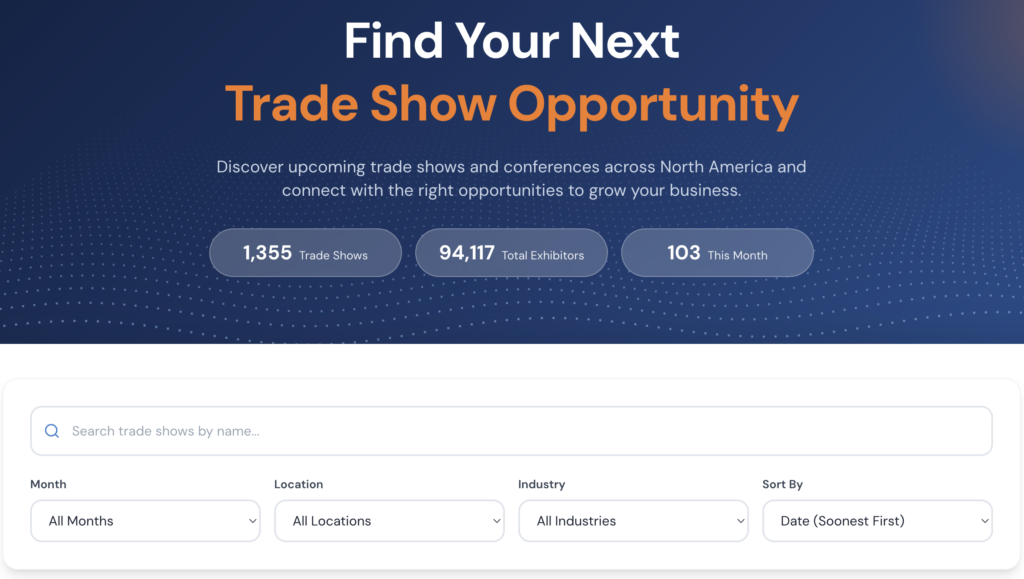
A dedicated trade show directory
is one of the fastest ways to identify relevant events without visiting dozens of association,
convention center, and event organizer websites individually.
Use TradeShows.fyi to search upcoming trade shows and conferences based on factors such as:
- Industry
- Event name
- City
- State
- Venue
- Date
- Geographic region
Start with a broad industry search and then narrow the results.
A commercial construction supplier, for example, might explore events related to construction,
architecture, facilities management, property development, building materials, and municipal
purchasing. Searching only one exact category could cause the company to overlook valuable
adjacent markets.
Create an initial list of approximately 10 to 20 possible events. At this stage, the purpose is
discovery rather than making a final decision.
Browse upcoming trade shows and industry events on Tradeshoweventdirectory.com
3. Search for Trade Shows by Industry
Industry relevance is usually more important than total attendance.
A general business expo with 20,000 visitors may generate fewer qualified conversations than a
specialized conference with 1,500 attendees from your exact market.
Search both your primary industry and related verticals. Useful search combinations include:
- “[Industry] trade shows”
- “[Industry] conferences”
- “[Industry] expos”
- “[Industry] conventions”
- “[Industry] supplier events”
- “[Industry] trade shows in the United States”
- “[Industry] trade shows near me”
- “[Industry] events 2027”
Also consider the industries your customers serve.
A company that manufactures packaging equipment should not limit its search to packaging trade
shows. Its potential buyers may also attend food-processing, pharmaceutical, cosmetics,
logistics, manufacturing, and ecommerce fulfillment events.
This customer-centered approach often uncovers opportunities your direct competitors have missed.
4. Decide Whether the Attendee Profile Matches Your Ideal Customer
An event’s topic may sound perfect while its actual audience is not.
Before committing, determine who attends the show. Look for an attendee profile, event prospectus,
post-show report, media kit, or exhibitor brochure.
Evaluate details such as:
- Industries represented
- Company sizes
- Job titles
- Seniority levels
- Purchasing authority
- Geographic reach
- Percentage of attendees compared with exhibitors
- Number of first-time attendees
- Most common reasons for attending
The most important question is simple:
Will enough of our ideal customers be in the building?
For a business selling enterprise software, thousands of students or entry-level professionals
may not provide the right opportunity. For a company introducing a consumer product, however,
an event with retailers, influencers, media representatives, and distributors could be highly
valuable even if direct consumer attendance is limited.
Ask the organizer for the most recent verified attendee information. Avoid relying entirely on a
large headline registration number without understanding who that number includes.
5. Study the Exhibitor List
The exhibitor list can reveal almost as much as the attendee profile.
Review current and previous exhibitors to determine:
- Whether your direct competitors participate
- Whether complementary businesses attend
- Whether major industry brands support the event
- Whether potential partners or suppliers exhibit
- Whether the show floor appears active and established
- Whether the event is dominated by a few large companies
Competitor participation is not automatically a reason to avoid an event. In many cases, it
confirms that buyers expect to find your type of product or service there.
However, examine how many similar companies will be competing for the same visitors. A crowded
category may require a stronger booth strategy, a clearer message, or a more visually distinctive
trade show display.
The exhibitor list may also reveal partnership opportunities. A software company might coordinate
with hardware vendors, consultants, or integration partners. A manufacturer may schedule meetings
with distributors and suppliers before the event begins.
6. Compare Total Exhibiting Cost, Not Just Booth-Space Cost
Booth-space pricing is only one component of the total investment.
A realistic trade show budget may include:
- Exhibit-space rental
- Registration fees
- Trade show display hardware
- Custom graphics
- Furniture and flooring
- Electrical service
- Internet service
- Material handling or drayage
- Freight and shipping
- Installation and dismantling labor
- Lead-retrieval equipment
- Promotional products
- Travel
- Hotels
- Meals
- Staff wages
- Sponsorships
- Advertising
- Post-show follow-up
A moderately priced booth in an expensive convention city may ultimately cost more than a larger
exhibit at a regional event.
Estimate the complete cost of each show before comparing opportunities. Then calculate how many
sales—or how much pipeline—you would need to justify the investment.
Simple Trade Show Break-Even Formula
Total event cost ÷ average gross profit per new customer = customers needed to break even
Suppose your total investment is $20,000 and your average gross profit from a new customer is
$4,000. You would need five new customers to recover the event cost.
That does not mean every deal must close immediately after the show. Trade show leads may develop
over several months. The calculation simply gives your team a concrete performance benchmark.
7. Evaluate the Location, Venue, and Timing
Location affects cost, attendance, staffing, shipping, and overall convenience.
Consider:
- Proximity to your existing customer base
- Strength of the local industry
- Driving and flight accessibility
- Hotel availability
- Shipping distance
- Union or venue labor requirements
- Seasonal weather
- Conflicts with holidays
- Conflicts with other major industry events
- Your internal sales and production calendar
Regional trade shows can be especially valuable for small and midsize businesses. They generally
cost less to attend, require less travel, and may provide more time for meaningful conversations.
Large national shows offer broader exposure but also bring greater competition and higher costs.
International events may create access to new markets while introducing additional freight,
customs, travel, language, and regulatory considerations.
Use a trade show calendar
to view events across the year rather than evaluating each show independently. Several good events
occurring within a few weeks of one another may strain your staff, inventory, and follow-up capacity.
8. Research the Event’s History and Reputation
A polished event website does not necessarily prove that a show is established or well attended.
Before registering, investigate:
- How long the event has operated
- Whether it is organized by a recognized association
- Whether attendance has grown or declined
- Whether prior exhibitors return
- Whether previous events generated active social-media coverage
- Whether educational sessions feature credible speakers
- Whether the organizer publishes post-show reports
- Whether exhibitors have raised recurring complaints
- Whether dates or venues have changed repeatedly
Search for photos and videos from previous years. Images of the actual show floor can help confirm
whether the event attracts meaningful traffic and whether exhibitor claims appear realistic.
Speaking with previous exhibitors is even more useful. Ask what type of attendees visited their
booth, whether the organizer met expectations, and whether they plan to return.
Be cautious when evaluating a first-year event. New shows can create excellent opportunities, but
registration forecasts are inherently less reliable because there is no prior attendance history.
9. Review Marketing and Sponsorship Opportunities
The value of a trade show is not limited to the physical booth.
Many events offer additional exposure through:
- Educational sessions
- Panel discussions
- Product demonstrations
- Event apps
- Email sponsorships
- Website listings
- Printed show guides
- Floor graphics
- Registration-area branding
- Charging lounges
- Networking receptions
- Press rooms
- Digital advertising
- Hosted-buyer meetings
Some opportunities are expensive without delivering much additional value. Others can dramatically
improve visibility.
A speaking session can establish credibility before attendees ever reach the exhibit hall. An
enhanced directory listing can help buyers find your company during and after the event. A
well-placed sponsorship may be worthwhile when it reaches the exact audience you want.
Evaluate sponsorships using the same standards as the show itself: audience fit, measurable exposure,
cost, and alignment with your objective.
10. Determine Whether Your Booth Can Compete Effectively
Finding the right event is only part of the decision. You also need a booth capable of attracting
and serving the expected audience.
Consider:
- Available booth sizes
- Competitor exhibit sizes
- Expected aisle traffic
- Product demonstration requirements
- Storage needs
- Meeting-space needs
- Electrical requirements
- Display height restrictions
- Hanging-sign rules
- Setup and dismantling requirements
- Whether the exhibit will be shipped or transported by your staff
A portable 10-by-10 display may be ideal for a regional show or a company testing an event for the
first time. A modular 10-by-20 booth may provide better space for demonstrations and meetings.
Backlit displays can increase visual contrast on a crowded show floor, while banner stands can
support specific promotions or product messages.
APG Exhibits
offers trade show displays ranging from portable banner stands and pop-up systems to backlit SEG
displays, modular exhibits, hanging structures, and custom booth configurations. The right choice
depends on booth size, travel frequency, staffing, brand positioning, and budget.
Explore trade show displays and exhibit solutions from APG Exhibits.
Do not wait until the final weeks before the show to plan the booth. Design, graphic production,
shipping, electrical orders, and venue paperwork all require lead time.
11. Score Each Trade Show Before Making a Decision
A standardized scoring system prevents your team from choosing events based primarily on familiarity,
emotion, or organizer sales pressure.
Score each candidate from one to five in the following categories:
| Evaluation Factor | Score |
|---|---|
| Audience fit | 1–5 |
| Number of qualified prospects | 1–5 |
| Industry relevance | 1–5 |
| Geographic value | 1–5 |
| Exhibitor and competitor quality | 1–5 |
| Total cost | 1–5 |
| Timing | 1–5 |
| Speaking and sponsorship opportunities | 1–5 |
| Event reputation | 1–5 |
| Probability of measurable ROI | 1–5 |
You can give additional weight to the factors that matter most. Audience fit and qualified-buyer
potential, for example, may count twice as much as location convenience.
Classify each event as:
- Priority event: Strong strategic and financial fit
- Test event: Promising but requires validation
- Attend only: Valuable for networking or research without exhibiting
- Monitor: Reconsider next year
- Decline: Insufficient audience fit or return potential
This process also creates a record of why the company selected or rejected each show.
12. Consider Attending Before Exhibiting
When uncertainty remains, attend the show as a visitor before purchasing exhibit space.
Walking the floor allows you to evaluate:
- Actual traffic
- Attendee quality
- Competitor participation
- Booth sizes
- Popular exhibit locations
- Educational programming
- Networking activity
- Organizer professionalism
- Whether exhibitors appear satisfied
Schedule meetings while attending so the trip produces immediate value. Introduce yourself to the
event’s sales team and ask about booth availability, historical renewal rates, attendee demographics,
and early-registration deadlines.
An attendee-only visit is not always practical, especially for annual events, but it can prevent a
much larger investment in the wrong show.
13. Build an Annual Trade Show Calendar
Once you identify the strongest opportunities, organize them into a single annual calendar.
For each event, track:
- Event name
- Industry
- City and venue
- Show dates
- Registration deadline
- Early-bird deadline
- Booth-selection date
- Hotel deadline
- Artwork deadline
- Shipping deadline
- Setup date
- Assigned staff
- Budget
- Primary objective
- Lead goal
- Follow-up owner
- Final results
Planning the entire year helps your team reuse display hardware, update graphics efficiently,
consolidate shipping, allocate staff, and avoid overlapping deadlines.
It also gives sales and marketing teams enough time to contact customers and prospects before
each event.
How Far in Advance Should You Find and Book a Trade Show?
For major national events, begin researching approximately nine to twelve months in advance.
Popular booth locations, nearby hotels, sponsorships, and speaking opportunities may be reserved early.
For regional and smaller events, four to six months may provide sufficient planning time, although
earlier is still preferable.
Nine to Twelve Months Before
- Research events
- Review prior results
- Establish objectives
- Reserve exhibit space
- Begin sponsorship discussions
Six to Nine Months Before
- Create the budget
- Select the booth configuration
- Reserve hotels
- Apply for speaking opportunities
- Plan product launches or demonstrations
Three to Six Months Before
- Finalize booth graphics
- Order displays
- Develop pre-show marketing
- Train booth staff
- Schedule meetings
One to Three Months Before
- Confirm shipping and venue services
- Promote your booth number
- Finalize lead-capture procedures
- Review staff schedules
- Test equipment and demonstrations
The larger or more customized the exhibit, the more planning time you should allow.
What Makes a Trade Show Worth Attending?
The best trade show is not necessarily the largest, oldest, or most famous. It is the event that
gives your company efficient access to the people who can help accomplish a defined business objective.
A worthwhile event generally offers:
- A strong concentration of relevant attendees
- Access to decision-makers
- Reasonable costs relative to potential value
- Credible organization and programming
- Opportunities for meetings and demonstrations
- Timing that supports your sales cycle
- A realistic path to measurable results
A smaller event that produces 25 qualified conversations can outperform a massive expo that
generates hundreds of badge scans from poorly matched visitors.
Quality matters more than raw traffic.
Track Results and Improve Your Trade Show Calendar Every Year
After each show, record more than the number of leads collected.
Measure:
- Qualified leads
- Sales meetings
- Product demonstrations
- Quotes requested
- Opportunities created
- Pipeline value
- Sales closed
- Revenue
- Gross profit
- Cost per lead
- Cost per opportunity
- Customer meetings
- Partner meetings
- Media mentions
- Website traffic
- Email-list growth
Also gather qualitative feedback from the booth team. Which messages attracted attention? What
questions did attendees ask? Which competitors stood out? Was the booth location effective? Did
the exhibit support conversations and demonstrations properly?
Review results after three, six, and twelve months. Some trade show opportunities have long sales
cycles and should not be judged only by immediate orders.
Use those findings to decide whether to expand, reduce, repeat, or eliminate the event the following year.
Start Finding Your Next Trade Show
A successful trade show program begins long before anyone steps onto the show floor.
Define your objective, search events by industry and location, verify the attendee profile, compare
total costs, and score every opportunity using consistent criteria. Then create an exhibit and
outreach plan designed specifically for the audience you expect to meet.
TradeShows.fyi makes the discovery process easier by bringing upcoming trade shows, conventions,
expos, and industry events into one searchable directory.
Search the TradeShows.fyi event directory.
Once you have selected the right event, APG Exhibits can help you create a professional booth
presence with portable, modular, backlit, and custom trade show display solutions for a wide
range of spaces and budgets.
Browse trade show displays from APG Exhibits.
Frequently Asked Questions
How do I find trade shows in my industry?
Search a trade show directory using your industry, related industries, customer markets,
location, and preferred dates. Then verify each event through its official website,
attendee profile, exhibitor list, and prior show reports.
How can I find trade shows near me?
Search by city, state, region, venue, or driving distance. Convention center calendars and
geographic pages within a trade show directory can also help identify local and regional events.
How do I choose which trade show to exhibit at?
Compare audience fit, qualified-buyer potential, event reputation, total cost, timing,
location, competitor participation, and expected return. Use a standardized scorecard
rather than selecting events based only on size or familiarity.
Are larger trade shows always better?
No. Large events provide broader exposure but also involve higher costs and more competition.
Smaller industry-specific shows may produce a higher concentration of qualified prospects
and better opportunities for meaningful conversations.
How much does it cost to exhibit at a trade show?
The total varies significantly based on booth size, city, travel, shipping, display type,
venue services, labor, and sponsorships. Calculate the complete cost rather than comparing
booth-space fees alone.
Should a small business exhibit at trade shows?
Yes, when the event attracts the company’s ideal customers and the likely opportunity
justifies the expense. Small businesses can begin with regional events, smaller booth spaces,
portable displays, and clearly defined lead goals.
How early should I book a trade show booth?
Major shows should often be researched nine to twelve months in advance. Smaller regional
events may require four to six months, but early booking generally provides better booth
selection, travel options, and planning time.
What information should I request from a trade show organizer?
Request recent attendance numbers, attendee demographics, job-title data, exhibitor lists,
post-show reports, floor plans, sponsorship options, renewal rates, and a complete list of
exhibitor fees and deadlines.
How do I calculate trade show ROI?
Subtract the total event cost from the gross profit attributable to the event, divide the
result by the total event cost, and multiply by 100. Continue tracking opportunities after
the show because some leads may take months to close.
About the Author